- Difference between aliphatic and aromatic
- Difference between alkanes, alkenes, alkynes
- What is a organic compound
- What is unique about carbon
- Nomenclature
Tuesday, April 29, 2014
Quiz on Wednesday
Study:

Hydrocarbons
What are hydrocarbons?
- The simplest aliphatic and aromatic compounds
- Only contain hydrogen and carbon
- Can contain single, double, or triple bonds
- Classified by the types of bonds.
Alkanes
- Alkanes are aliphatic hydrocarbons that only contain single bonds.
- The general formula for alkanes is CnH2n+2
- Example: CH4, C2H6, C3H8
- Considered saturated because carbon is surrounded by the max number of hydrogen.
- Methane is the simples alkane (CH4)
- Each consecutive alkane adds a carbon and its respective hydrogens.
- Methane: 1 carbon
- Ethane: 2 carbons
- Propane: 3 carbon
- Butane: 4 carbons
- Properties of Alkanes
- Very low melting and boiling points. They rise as carbons are added.
- Ex. methane
- Melting point (C): -183
- Boiling point (C): -164
- Non-polar
- Hydrocarbons that contain double bonds between carbon atoms
- Contain the prefix -ene.
- The smallest is ethene. Why not methene?
- Considered unsaturated, because the double bond prevents the max number of hydrogen from bonding.
- Naming of alkenes requires numbering the carbons to identify the place where the double bond is.
- You start at the carbon that will give you the smallest number.
- This allows us to know where the double bond is.
- Properties of Alkenes:
- Slightly higher melting/boiling points
- The first couple are gases at room temperature
- Relatively non polar
Alkynes
- Hydrocarbons that contain triple bonds between the carbon atoms
- Uses the prefix -yne
- The simplest is the most common, ethyne (acetylene).
Cyclic Aliphatic Compounds
- Not all hydrocarbons are open chains of carbon atoms.
- Some form a ring.
- 5 and 6 alkane rings are most abundant.
- Some can have more than one double bond.
Aromatic Structures
- All contain a form of a molecule benzene
- They are called aromatic because they often smell good
- C6H6 is the simplest aromatic compound known
- It was hard to figure out the structure:
- Behaves like an alkane, but they knew from the molecular weight that it had several double and triple bonds.
- When they measured the bond length, the found that it should contain 1.5 bond lengths.
- Showed that carbon was in a ring and all had identical bonds
- In 1865, August Kekule proposed the structure.
- He said that it was a dynamic equilibrium of the two.
- The double bonds were not “tied dow”, but are more or less shared.
Organic Chemistry Introduction
- Organic Compounds: covalently bonded carbon compounds, with the exception of carbonates, carbon oxides, and carbides.
- Biochemistry: the study of complex reactions taking place between organic compounds within living organisms.
Unique Carbon Atom
- Carbon has some unique properties that enable it to form hundreds of thousands of compounds.
- Carbon has 4 valence electrons, requiring 4 bonds to obtain an octet
- Carbon forms strong chemical bonds with other carbon atoms
- Carbon forms stable, almost non polar bonds with hydrogen
- Carbon atoms can bond to a wide variety of atoms
- H, P, O, N, S, the halogens, and even metal atoms.
- Bonds can be straight, branched, and in various lengths.
- They can even form rings
- Can form double and triple bonds
Structural Forumlas
- Structural formulas are used a lot in organic chemistry because molecular formulas can mean various compounds.
- C2H6O can mean ethanol or dimethyl ether
- See page 446 in your books
Classification
- There are approx. 300,000 new organic compounds synthesized for the first time every year.
- It is important to have some categories:
- Aliphatic compounds: without a benzene ring
- Aromatic compounds: with a benzene ring
Friday, March 28, 2014
Redox Reactions
- Oxidation-reduction reactions (redox reactions):
- Reactions involving transfers or shifts of electrons
- Oxidation:
- A loss of electrons which makes the oxidation number go up
- Occurs mainly in metals
- Occurs in some covalently bonded substances
- Does not require oxygen (that is not what oxidation means!)
- Reduction:
- A gain of electrons that makes the oxidation number go down (reduced)
- Occurs mainly in nonmetals that gain electrons by taking them from metals
- Review of oxidation numbers:
- Rule 1: free atoms = 0
- Rule 2: ion charge = oxidation number
- Rule 3: compound sum = 0
- Rule 4A: Group 1 = +1
- Rule 4B: Group 2 = +2
- Rule 4C: H = +1 or -1
- Rule 4D: O = -2 or -1
- Rule 4E: Group 17 = -1
- Rule 5: sum of ONs in polyatomic ion = charge
- Practice: Assign Oxidation Numbers
- H2CO3
- H: +1, O: -2, C: +4
- N2
- N: 0
- Zn(OH)4-2
- Zn: +2, H: +1, O: -2
Redox
- Short for reduction-oxidation
- Pronounced “REE-docs”
- Must occur together (An element cannot take electrons without another one losing them.)
- LEO the GERm
- Lose Electrons Oxidation
- Gain Electrons Reduction
- Determine which element is oxidized and which is reduced?
- Zn + 2H+ ➝ Zn2+ + H2
- Zn is oxidized (ON: 0 ➝ +2)
- H+ is reduced (ON: +1 ➝ 0)
- 3Hg2+ + 2 Fe(s) ➝ 3Hg + 2Fe3+
- Hg2+: reduced
- Fe: oxidized
- Oxidizing and Reducing Agents:
- Reducing agent is a substance used to reduce another substance.
- If a substance is oxidized it is the reducing agent.
- Oxidizing agent is a substance used to oxidize another substance.
- If a substance is reduced it is the oxidizing agent.
- Example:
- Zn + 2H+ ➝ Zn2+ + H2
- Zn is oxidized (ON: 0 ➝ +2) [REDUCING AGENT]
- H+ is reduced (ON: +1 ➝ 0) [OXIDIZING AGENT]
- 3Hg2+ + 2 Fe(s) ➝ 3Hg + 2Fe3+
- Hg2+: reduced [OXIDIZING AGENT]
- Fe: oxidized [REDUCING AGENT]
Balancing Redox Reactions
See practice for the procedure, but here are the steps:
- Assign oxidation numbers
- Make half reactions (oxidized reaction and reduced reaction) [forget everything else for now]
- Balance electrons
- Add everything back in and balance traditionally [see Chapter 8 for procedure]
Answers to Chapter 17 Practice 28/03
Here are the answers and more or less how to do the process. If you have any questions, you can email me or ask on Monday.
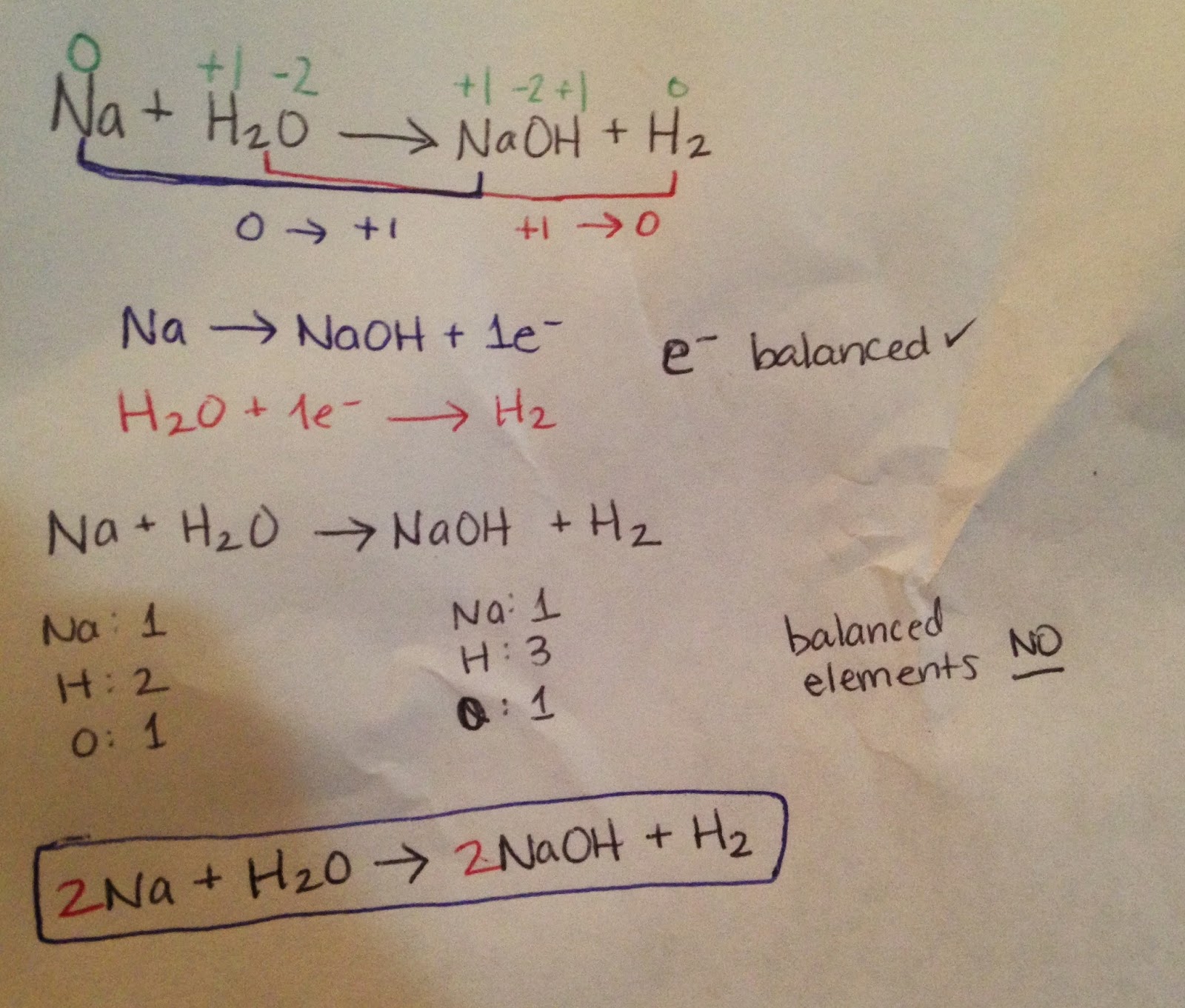
Oxidized/Reducing Agent: Na
Reduced/Oxidizing Agent: H2O

Oxidized/Reducing Agent: HCl
Reduced/Oxidizing Agent: HNO3
Oxidized/Reducing Agent: Fe
Reduced/Oxidizing Agent: SnCl4

Oxidized/Reducing Agent: CO
Reduced/Oxidizing Agent: I2O5

Oxidized/Reducing Agent: Fe2+
Reduced/Oxidizing Agent: MnO4-

Oxidized/Reducing Agent: Fe
Reduced/Oxidizing Agent: Cu+
Thursday, March 20, 2014
Review for Test
- Definitions of acids/bases.
- Properties
- Arrhenius defnition
- Bronsted-Lowry definiton
- Conjugate pairs
- Lewis definition
- Acid Base Equilibria
- Self-Ionization of Water (Kw)
- pH, pOH, [H3O+], [OH-]
- pH scale and values
- Acid-Base Strength (Concentration vs. Strength)
- Ka and Kb
- Polyprotic Acids
- Titration
- Buffers
- Important Equations:
- Kw = [H3O+][OH-] = 1.0 x 10⁻¹⁴
- pH = -log[H3O+]
- [H3O+] = 10-pH
- pOH = -log[OH-]
- [OH-] = 10-pOH
- pH + pOH = 14
- (MK)(VK)=(MU)(VU)
- In the following chemical reactions, identify the acid, base, conjugate acid, and conjugate base.
- HC2H3O2 + H2O ⇌ H3O+ + C2H3O2-
- NH3 + H2O ⇌ NH4+ + OH-
- HNO3 + H2O ⇌ NO3- + H3O+
- Find the [H3O+] and pH of the following:
- 0.025 M HNO3
- 3.4 x 10⁻⁴ M H2SO4
- Calculate the [H3O+] and pOH of the following solutions:
- pH = 3.2
- pH = 5.0
- [OH-] = 8.2 x 10⁻⁹
- pH = 12.4
- Find the [OH-] of the following solutions:
- [H3O+] = 3.9 x 10⁻⁶ M
- [H3O+] = 0.0014 M
- pH = 4.2
- If 35.2 mL of 12M HCl is used to titrate 50.0 mL of KOH, what is the concentration of the KOH?
- What is the volume of 2.5 M NaOH needed to titrate 25.0 mL of 1.0 M HCl?
- Given the following equation, find the concentration of NaOH when 24.09 mL of 1.605 M H2SO4 is needed to titrate 50.0 mL of NaOH. H2SO4 + 2NaOH ➝ Na2SO4 + 2H2O
- What is the salt that is formed during the following neutralization reactions?
- Mg(OH)2 + HCl ➝ ? + H2O
- H2SO4 + 2NH4O ➝ ? + 2H2O
- Ni(OH)2 + 2HClO4 ➝ ? + 2H2O
- Mg(OH)2 + H2SO4 ➝ ? + 2H2O
Answers:
- Identifying the acid, base, conjugate acid, and conjugate base.
- Acid: HC2H3O2Base: H2OC. Acid: H3O+C. Base: C2H3O2-
- Acid: H2OBase: NH3C. Acid: OH-C. Base: NH4+
- Acid: HNO3Base: H2OC. Acid: H3O+C. Base: NO3-
- Find the [H3O+] and pH of the following:
- [H3O+] = 0.025 & pH = 1.6
- [H3O+] = 6.8 x 10⁻⁴ & pH = 3.1
- Calculate the [H3O+] and pOH of the following solutions:
- [H3O+] = 6.0 x 10⁻⁴ & pOH = 10.8
- [H3O+] = 1.0 x 10⁻⁵ & pOH = 9
- [H3O+] = 1.2 x 10⁻⁶ & pOH = 8.1
- [H3O+] = 4.0 x 10⁻¹³ & pOH = 1.6
- Find the [OH-] of the following solutions:
- [OH-] = 2.5 x 10⁻⁹
- [OH-] = 7.1 x 10⁻¹²
- [OH-] = 1.6 x 10⁻¹⁰
- 8.4 M KOH
- 10.0 mL of NaOH
- 1.5 M NaOH
- What is the salt that is formed during the following neutralization reactions?
- MgCl2
- (NH4)2SO4
- Ni(ClO4)2
- MgSO4
Thursday, March 6, 2014
Acid Base Equilibrium
- Why can we eat and drink some acids and bases and not others?
- The degree to which they release or accept protons
- Equilibrium constants describe how readily acids deprotonate and bases protonate.
Self-Ionization of Water
One molecule accepts and one donates a proton.
This is called self-ionization

- This reaction is very important. Because it gives us a constant for acid base equilibrium. Kw is the equilibrium constant for water.
- Kw = [OH-][H3O+] = 1.0 x 10⁻¹⁴ M
- Note: M stands for molarity which is moles/L
- Whether a solution is acidic, basic or neutral, the product of the [H3O+] and [OH-] is always equal to Kw.
- Example problem:
- The [H3O+] in a mild acid is found to be 5 x 10⁻⁷ mol/L. What is the concentration (molarity) of hydroxide ions?
- [OH-][H3O+] = 1.0 x 10⁻¹⁴ M
- [OH-] = 1.0 x 10⁻¹⁴ M/[H3O+]
- [OH-] = 1.0 x 10⁻¹⁴ M/5.0 x 10-7 M
- [OH-] = 2.0 x 10⁻⁸ M
pH Scale
- pH stands for “power of hydronium”
- pH is the negative logarithm of the [H3O+]
- pH = -log [H3O+]
- Examples:
- If [H3O+] = 0.0025 M
- pH = -log(0.0025) = 2.6
- If [H3O+] = 4.57 x 10⁻⁹ M
- pH = -log(4.57 x 10⁻⁹ M) = 8.34
pH Values
- A pH of 7 means neutral.
- A pH of 0-7 is an acid.
- A pH of 7-14 is basic
 |
| pH Scale |
- Example 1:
- The [H3O+] in a shampoo is 2.0 x 10⁻⁵ M. What is the pH of this shampoo?
- pH = -log [H3O+]
- pH = -log(2.0 x 10⁻⁵) = 4.7
- Example 2:
- What is the pH of an aqueous solution of 0.40 g of HI dissolved in 500 mL of water?
- First, convert grams of HI to moles of HI.
- 0.4 g HI x (1 mol HI/127.9 g HI) = 0.00031 mol HI
- Next calculate molarity (M).
- (0.0031 mol HI/500 mL) x (1000 mL/1L) = 6.3 x 10⁻³ M
- Solution:
- pH = -log[H3O+
- = -log(6.3 x 10⁻³ M)
- = 2.2
- Example 3
- Find the pH of a solution whose [H3O+] equals 9.5 x 10⁻⁸.
- pH = -log[H3O+]
- = -log(9.5 x 10⁻⁸ M)
- = 7.02
Subscribe to:
Posts (Atom)