Tuesday, April 29, 2014

Organic Chemistry Introduction


  • Organic Compounds: covalently bonded carbon compounds, with the exception of carbonates, carbon oxides, and carbides.
  • Biochemistry: the study of complex reactions taking place between organic compounds within living organisms.
Unique Carbon Atom

  • Carbon has some unique properties that enable it to form hundreds of thousands of compounds.
    • Carbon has 4 valence electrons, requiring 4 bonds to obtain an octet
    • Carbon forms strong chemical bonds with other carbon atoms
    • Carbon forms stable, almost non polar bonds with hydrogen
    • Carbon atoms can bond to a wide variety of atoms
      • H, P, O, N, S, the halogens, and even metal atoms.
    • Bonds can be straight, branched, and in various lengths.
    • They can even form rings
    • Can form double and triple bonds
Structural Forumlas
  • Structural formulas are used a lot in organic chemistry because molecular formulas can mean various compounds. 
  • C2H6O can mean ethanol or dimethyl ether
  • See page 446 in your books
Classification
  • There are approx. 300,000 new organic compounds synthesized for the first time every year.
  • It is important to have some categories:
    • Aliphatic compounds: without a benzene ring
    • Aromatic compounds: with a benzene ring

Friday, March 28, 2014

Redox Reactions


  • Oxidation-reduction reactions (redox reactions):
    • Reactions involving transfers or shifts of electrons 
  • Oxidation:
    • A loss of electrons which makes the oxidation number go up
    • Occurs mainly in metals
    • Occurs in some covalently bonded substances
    • Does not require oxygen (that is not what oxidation means!)
  • Reduction:
    • A gain of electrons that makes the oxidation number go down (reduced)
    • Occurs mainly in nonmetals that gain electrons by taking them from metals
  • Review of oxidation numbers:
    • Rule 1: free atoms = 0
    • Rule 2: ion charge = oxidation number
    • Rule 3: compound sum = 0
    • Rule 4A: Group 1 = +1
    • Rule 4B: Group 2 = +2
    • Rule 4C: H = +1 or -1
    • Rule 4D: O = -2 or -1
    • Rule 4E: Group 17 = -1
    • Rule 5: sum of ONs in polyatomic ion = charge
    • Practice: Assign Oxidation Numbers
      • H2CO3
        • H: +1, O: -2, C: +4

      • N2
        • N: 0
      • Zn(OH)4-2
        • Zn: +2, H: +1, O: -2
Redox
  • Short for reduction­-oxidation
  • Pronounced “REE-docs”
  • Must occur together (An element cannot take electrons without another one losing them.)
  • LEO the GERm
    • Lose Electrons Oxidation
    • Gain Electrons Reduction
  • Determine which element is oxidized and which is reduced?
    • Zn + 2H+ ➝ Zn2+ + H2
      • Zn is oxidized (ON: 0 ➝ +2)
      • H+ is reduced (ON: +1 ➝ 0)
    • 3Hg2+ + 2 Fe(s) ➝ 3Hg + 2Fe3+
      • Hg2+: reduced 
      • Fe: oxidized
  • Oxidizing and Reducing Agents:
    • Reducing agent is a substance used to reduce another substance.
      • If a substance is oxidized it is the reducing agent.
    • Oxidizing agent is a substance used to oxidize another substance.
      • If a substance is reduced it is the oxidizing agent.
    • Example:
      • Zn + 2H+ ➝ Zn2+ + H2
        • Zn is oxidized (ON: 0 ➝ +2) [REDUCING AGENT]
        • H+ is reduced (ON: +1 ➝ 0) [OXIDIZING AGENT]
      • 3Hg2+ + 2 Fe(s) ➝ 3Hg + 2Fe3+
        • Hg2+: reduced [OXIDIZING AGENT]
        • Fe: oxidized [REDUCING AGENT]
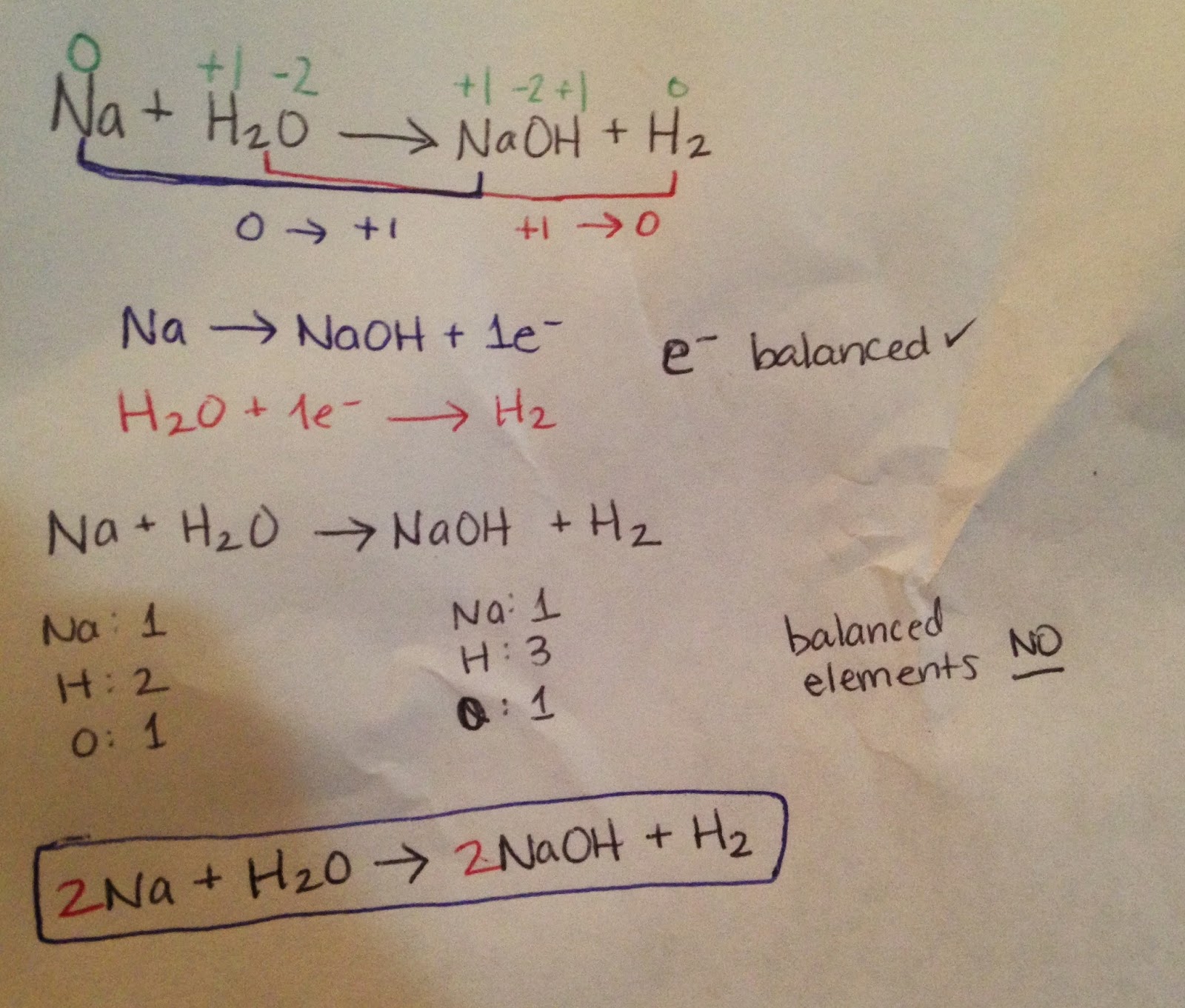
Balancing Redox Reactions

See practice for the procedure, but here are the steps:
  1. Assign oxidation numbers
  2. Make half reactions (oxidized reaction and reduced reaction) [forget everything else for now]
  3. Balance electrons
  4. Add everything back in and balance traditionally [see Chapter 8 for procedure]

Answers to Chapter 17 Practice 28/03

Here are the answers and more or less how to do the process. If you have any questions, you can email me or ask on Monday.

Oxidized/Reducing Agent: Na 

Reduced/Oxidizing Agent: H2O 


Oxidized/Reducing Agent: HCl 
Reduced/Oxidizing Agent: HNO3


Oxidized/Reducing Agent: Fe
Reduced/Oxidizing Agent: SnCl4


Oxidized/Reducing Agent: CO

Reduced/Oxidizing Agent: I2O5

Oxidized/Reducing Agent:  Fe2+

Reduced/Oxidizing Agent: MnO4-


Oxidized/Reducing Agent: Fe
Reduced/Oxidizing Agent: Cu+

Thursday, March 20, 2014

Review for Test

  1. Definitions of acids/bases.
    • Properties
    • Arrhenius defnition
    • Bronsted-Lowry definiton
      • Conjugate pairs
    • Lewis definition
  2. Acid Base Equilibria
  3. Self-Ionization of Water (Kw)
  4. pH, pOH, [H3O+], [OH-]
  5. pH scale and values
  6. Acid-Base Strength (Concentration vs. Strength)
    • Ka and Kb
  7. Polyprotic Acids
  8. Titration
  9. Buffers
  10. Important Equations:
    • Kw = [H3O+][OH-] = 1.0 x 10⁻¹⁴
    • pH = -log[H3O+]
    • [H3O+] = 10-pH
    • pOH = -log[OH-]
    • [OH-] = 10-pOH
    • pH + pOH = 14
    • (MK)(VK)=(MU)(VU)


  1. In the following chemical reactions, identify the acid, base, conjugate acid, and conjugate base.
    • HC2H3O2 + H2O ⇌ H3O+ + C2H3O2-
    • NH3 + H2O ⇌ NH4+ + OH-
    • HNO3 + H2O ⇌ NO3- + H3O+
  2. Find the [H3O+] and pH of the following:
    • 0.025 M HNO3
    • 3.4 x 10⁻⁴ M H2SO4
  3. Calculate the [H3O+] and pOH of the following solutions:
    • pH = 3.2
    • pH = 5.0
    • [OH-] = 8.2 x 10⁻⁹
    • pH = 12.4
  4. Find the [OH-] of the following solutions:
    • [H3O+] = 3.9 x 10⁻⁶ M
    • [H3O+] = 0.0014 M
    • pH = 4.2
  5. If 35.2 mL of 12M HCl is used to titrate 50.0 mL of KOH, what is the concentration of the KOH?
  6. What is the volume of 2.5 M NaOH needed to titrate 25.0 mL of 1.0 M HCl?
  7. Given the following equation, find the concentration of NaOH when 24.09 mL of 1.605 M H2SO4 is needed to titrate 50.0 mL of NaOH.      H2SO4 + 2NaOH ➝ Na2SO4 + 2H2O
  8. What is the salt that is formed during the following neutralization reactions?
    • Mg(OH)2 + HCl ➝ ? + H2O
    • H2SO4 + 2NH4O ➝ ? + 2H2O
    • Ni(OH)2 + 2HClO4 ➝ ? + 2H2O
    • Mg(OH)2 + H2SO4 ➝ ? + 2H2O


Answers:
  1. Identifying the acid, base, conjugate acid, and conjugate base.
    • Acid: HC2H3O2Base: H2OC. Acid: H3O+C. Base: C2H3O2-
    • Acid: H2OBase: NH3C. Acid: OH-C. Base: NH4+ 
    • Acid: HNO3Base: H2OC. Acid: H3O+C. Base: NO3- 
  2. Find the [H3O+] and pH of the following:
    • [H3O+] = 0.025 & pH = 1.6
    • [H3O+] = 6.8 x 10⁻⁴ & pH = 3.1
  3. Calculate the [H3O+] and pOH of the following solutions:
    • [H3O+] = 6.0 x 10⁻⁴ & pOH = 10.8
    • [H3O+] = 1.0 x 10⁻⁵ & pOH = 9
    • [H3O+] = 1.2 x 10⁻⁶ & pOH = 8.1
    • [H3O+] = 4.0 x 10⁻¹³ & pOH = 1.6
  4. Find the [OH-] of the following solutions:
    • [OH-] = 2.5 x 10⁻⁹
    • [OH-] = 7.1 x 10⁻¹²
    • [OH-] = 1.6 x 10⁻¹⁰
  5. 8.4 M KOH
  6. 10.0 mL of NaOH
  7. 1.5 M NaOH
  8. What is the salt that is formed during the following neutralization reactions?
    • MgCl2
    • (NH4)2SO4
    • Ni(ClO4)2
    • MgSO4

Thursday, March 6, 2014

Acid Base Equilibrium

  • Why can we eat and drink some acids and bases and not others?
    • The degree to which they release or accept protons
  • Equilibrium constants describe how readily acids deprotonate and bases protonate.
Self-Ionization of Water

  • Water can react with itself.
  • One molecule accepts and one donates a proton. 
  • This is called self-ionization
    • This reaction is very important. Because it gives us a constant for acid base equilibrium. Kw is the equilibrium constant for water. 
      • Kw = [OH-][H3O+] = 1.0 x 10⁻¹⁴ M
      • Note: M stands for molarity which is moles/L
    • Whether a solution is acidic, basic or neutral, the product of the [H3O+] and [OH-] is always equal to Kw.
    • Example problem: 
      • The [H3O+] in a mild acid is found to be 5 x 10⁻⁷ mol/L. What is the concentration (molarity) of hydroxide ions?
        • [OH-][H3O+] = 1.0 x 10⁻¹⁴ M
        • [OH-] = 1.0 x 10⁻¹⁴ M/[H3O+]
        • [OH-] = 1.0 x 10⁻¹⁴ M/5.0 x 10-7 M
        • [OH-] = 2.0 x 10⁻⁸ M


    pH Scale
    • pH stands for “power of hydronium”
    • pH is the negative logarithm of the [H3O+]
      • pH = -log [H3O+]
    • Examples:
      • If [H3O+] = 0.0025 M
        • pH = -log(0.0025) = 2.6
      • If [H3O+] = 4.57 x 10⁻⁹ M
        • pH = -log(4.57 x 10-9 M) = 8.34

    pH Values
    • A pH of 7 means neutral.
    • A pH of 0-7 is an acid.
    • A pH of 7-14 is basic
    pH Scale
    • Example 1:
      • The [H3O+] in a shampoo is 2.0 x 10⁻⁵ M. What is the pH of this shampoo?
        • pH = -log [H3O+]
        • pH = -log(2.0 x 10⁻⁵) = 4.7
    • Example 2:
      • What is the pH of an aqueous solution of 0.40 g of HI dissolved in 500 mL of water?
      • First, convert grams of HI to moles of HI.
        • 0.4 g HI x (1 mol HI/127.9 g HI) = 0.00031 mol HI
      • Next calculate molarity (M).
        • (0.0031 mol HI/500 mL) x (1000 mL/1L) = 6.3 x 10⁻³ M 
      • Solution:
        • pH = -log[H3O+
        •       = -log(6.3 x 10⁻³ M)
        •       =  2.2
    • Example 3
      • Find the pH of a solution whose [H3O+] equals 9.5 x 10⁻⁸.
        • pH = -log[H3O+]
        •       = -log(9.5 x 10⁻⁸ M)
        •       =  7.02 

    Defining Acids and Bases

    • We live in a world full of chemicals. Some of these chemicals are compounds called acids and bases. We will talk about the properties and various ways of identifying acids and bases. In 1663, Robert Boyle started to classify compounds as acids and bases by their physical properties, but it would be another 200 years before scientists began to explain their chemical properties.
    Properties of Acids

    • Sour taste:
      • citric acid makes fruit juice tart
      • acetic acid makes pickles sour
      • acetylsalicylic acid makes aspirin sour
      • lactic acid gives the smell and flavor to sour milk
    • When some acids dissolve, they are able to conduct and electrical current. For example, HCl ionizes into hydrogen ions and chlorine ions. Any substance that ionizes to conduct electricity in a solution is called an electrolyte.
    • An acid turns blue litmus paper red.
    • Acids react with active metals to produce hydrogen gas and a salt.
      • Mg (s) + 2HCl (aq) → MgCl2 (aq) + H2 (g)

    Properties of Bases
    • Bitter taste
    • Slippery
    • Red litmus paper turns blue.
    • Neutralization reaction between an acid and a base in an aqueous solution produces a salt and water.
      • HCl (aq) + NaOH (aq) → NaCl (aq) + H2O

    The Arrhenius Model
    • Acids: 
      • Give a H+ ion (a proton) when in water.
      • This hydrogen ion is not stable so it bonds with the water to form the hydronium ion (H3O+)
      • Examples:
        • HCl + H2O → H3O+ + Cl-
        • CH3COOH + H2O → H3O+ + CH3COO-
    • Bases:
      • Gives an OH- ion (a hydroxide) when in water
      • Examples:
        • NaOH + H2O → OH- + Na+ + H2O
        • NH3 + H2O → OH- + NH4+
    • Limitations:
      • Not all substances with Hs or OHs are an acid or a base.
        • Examples: CH4 and CH3OH
      • Only works for acids and bases in water.

    The Bronsted Lowry Model
    • Acids: donate proton(s)
      • This is the same definition as in the Arrhenius model.
      • Donating or losing a proton is called deprotonation.
    • Bases: accept proton(s)
      • Much wider than Arrhenius because it includes substances that might not have an OH group.
      • Gaining or accepting a proton is called protonation.
    • Conjugate pairs:
      • This refers to acids and bases with common features. These common features are the equal loss/gain of protons between pairs. Conjugate acids and conjugate bases are characterized as the acids and bases that lose or gain protons.
      • Acid + base → conjugate base + conjugate acid
      • Example:
        • HC2H3O2 + H2O <—> H3O+ + C2H3O2-
          • Acid: HC2H3O2 because it donates a proton
          • Base: H2O because it accepts the proton
          • Conjugate acid: H3O+ because it would donate a proton
          • Conjugate base: C2H3O2- because it would accept the proton
        • HClO2 + H2O → ClO2- + H3O+
          • Acid: HClO2
          • Base: H2O
          • Conjugate acid: H3O+
          • Conjugate base: ClO2- 
        • OCl- + H2O → HOCl + OH-
          • Acid: H2O
          • Base: OCl- 
          • Conjugate acid: HOCl
          • Conjugate base: OH-
        • HCl- + H2PO4-  → Cl- + H3PO4
          • Acid: HCl- 
          • Base: H2PO4-
          • Conjugate acid: H3PO4
          • Conjugate base: Cl- 
    Lewis Model
    • Acids: accept a pair of e- (one empty orbital)
    • Bases: donate a pair of e- (one unbonded pair of electrons)

    Monday, February 24, 2014

    Stoichiometry

    • Let’s pretend we are going to a party and we want to bring marshmallow treats. Here is our recipe.
      • 3 T of butter
      • 40 marshmallows
      • 6 c of rice cereal
      • This will make 24 treats
    • We realize that we only have 4.5 cups of cereal. What do we do?
      • 4.5 c cereal x 40 marshmallows/6 c cereal
    • Would this be enough to feed the 20 people that are coming?
      • 4.5 c cereal x 24 treats/6 c cereal = 18 treats
    • We use this same process to determine how much of the products we need in chemistry to make a certain amount of reactant.
    • For example, in the equation P4 + 5O2 —> 2P2O5, we know that for every 1 molecule of of P4 and 5 molecules of O2, we are going to end up with 2 molecules of P2O5. 
      • This gives us various relationships in our equation:
        • 1 mol P4 reacts to form 2 mol P2O5 (1:2 ratio)
        • 1 mol P4 reacts with 5 mol O2 (1:5 ratio) and
        • 5 mol O2 reacts to form 2 mol P2O5 (5:2 ratio)
      • Even if we were to cut the original quantities in half or double them, we would still have the same ratio. These are known as mole ratios.
    • We can use these ratios to do mole-to-mole conversions. This would be to determine how much of a product we would get if we added a certain amount of reactants.
    • If a chemical engineer wanted to produce 25.0 mol of diphosphorus pentoxide, how many moles of phosphors would they need?
      • 25.0 mol P2O5 x 1 mol P4/2 mol P2O5 = 12.5 mol P4
    • What is the amount of oxygen needed?
      • 12.5 mol P4 x 5 mol O2/1 mol P4 = 62.5 mol O2
    • If 25.0 mol of diphosphorus pentoxide reacts with water to form phosphoric acid, how many moles of water is required? P2O5 + 3H2O —> 2H3PO4 
      • 25.00 mol P2O5 x 3 mol H2O/ 1 mol P2O5 = 75.0 mol H2O
    • Why must the conversions be done in moles? Because the recipe/balanced equation is based on moles, not mass. 
    • If we wanted to know the moles of diphosphorus pentoxide that would result from the burning of 1.55 kg of phosphorus from the previous equation, we first have to convert mass to moles.
      • 1550 g P4 x 1 mol/123.9 g P4 = 12.5 mol P4
      • Then we can use our ratio to determine the diphosphorus pentoxide that would result:
        • 12.5 mol P4 x 2 mol P2O5/1 mol p 4 = 25.0 mol P2O5
    • Example: How many moles of phosphoric acid can be formed from 3550 g of diphosphorus pentoxide? P2O5 + 3H2O —> 2H3PO4
      • First convert 3550 g P2O5 to moles.
        • 3550 g P2O5 x 1 mol P2O5/141.9 g P2O5 = 25.0 mol P2O5 
      • Then use ratio to figure out the rest
        • 25.0 mol P2O5 x 2 mol H3PO4/1 mol P2O5 = 50.0 mol H3PO4
    • What if we want need to figure out mass given mass? 
    • What mass of water will react with 3500 g of diphosphorus pentoxide? P2O5 + 3H2O —> 2H3PO4
      • 3550 g P2O5 x 1 mol P2O5/141.9 g P2O5 = 25.0 mol P2O5 
      • 25.0 mol P2O5 x 3 mol H2O/1 mol P2O5 = 75.0 mol H2O
      • 75.0 mol H2O x 18.02 g H2O/1 mol H2O = 1350 g H2O